> ## Documentation Index
> Fetch the complete documentation index at: https://docs.getvirtualbrain.com/llms.txt
> Use this file to discover all available pages before exploring further.
# Sharing Brains
> Share a Brain with named colleagues at full or read-only access, or with a whole team read-only. Brains stay private until you decide otherwise
Brains are private to you by default. When you're ready to collaborate, share with named colleagues at full access or read-only, or with an entire team read-only, so the right people can query the engagement's knowledge without weakening its confidentiality boundary.
## Why per-Brain sharing matters
Sharing is controlled per-Brain, so access maps to how your work is actually structured: the deal team sees the deal room, the coverage group sees the sector library, and nothing leaks between them. You stay in command of who sees what, engagement by engagement.
## Share a Brain
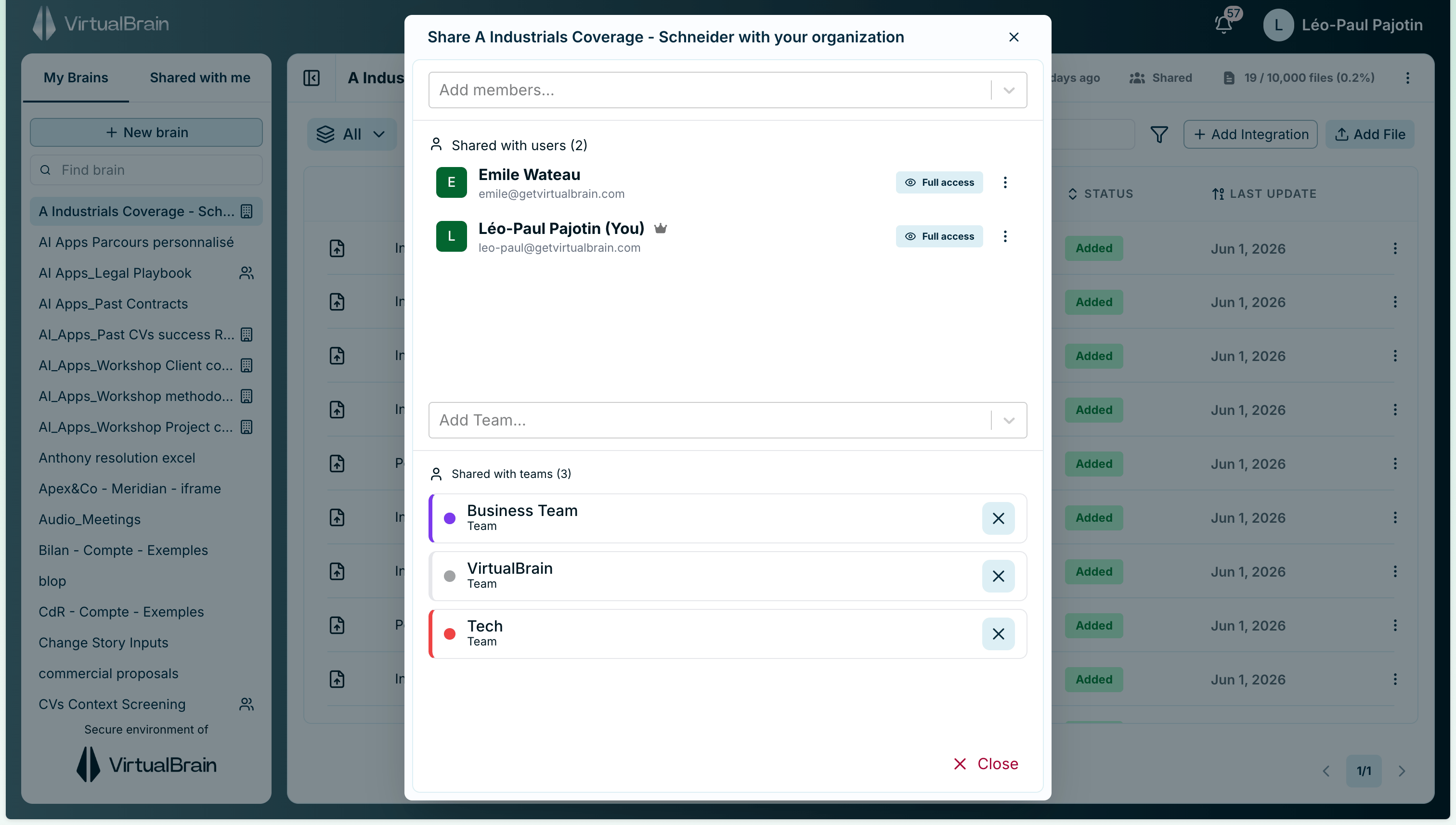
The share action sits in the Brain's header.
Type a colleague's name under **Add members**, or add a whole Team. The owner is marked with a crown.
Grant a colleague **Full access**, or read-only so they can query the Brain without changing its contents. A team is always read-only.
## Access levels
A Brain has one owner and any number of people it's shared with, at one of two levels. Here is who can do what:
| Action | Owner | Full access | Read-only |
| ----------------------------------- | :---: | :---------: | :-------: |
| Query the Brain | Yes | Yes | Yes |
| Add and remove documents | Yes | Yes | No |
| Rename and edit the description | Yes | Yes | No |
| Share with, or remove, other people | Yes | Yes | No |
| Delete the Brain | Yes | Yes | No |
| Transfer ownership | Yes | No | No |
**Sharing with a team is always read-only.** When you share a Brain with a whole team, its members get read-only access: they can query the Brain, but can't add or remove its documents. Give an individual **Full access** when they need to manage what's inside.
### Owner vs. full access
**Full access** and the **owner** can do almost everything: add and remove documents, rename the Brain, share it, and delete it. The one thing reserved for the owner is **transferring ownership**. The owner is marked with a crown in the sharing dialog.
### Transfer ownership
When someone changes role or hands an engagement over, the owner can transfer the Brain to another member of the same organization. The new owner receives full access and becomes the crowned owner, and any connected [cloud-storage integrations](/features/brains/connectors) move to them so syncing keeps working. The previous owner keeps full access unless you remove them, so nothing breaks mid-transfer; remove them afterward if they should no longer reach the Brain.
**Before deleting a user, rescue the Brains they own.** When a user is removed from the workspace, their owned Brains are handled by what they're shared with: a Brain shared with at least one other person or a team is automatically transferred to a workspace administrator, so the team keeps it. A **private Brain that no one else can access is permanently deleted, along with its documents**. If a departing colleague owns Brains worth keeping, share them or [transfer ownership](#transfer-ownership) first.
## Best practices
Before sharing, [give the Brain a description](/features/brains/organizing-documents): colleagues without full access see only the title, owner, document count, and description, so a clear description is how they know what they're looking at. Reserve **Full access** for the colleagues who maintain the Brain's contents; everyone else queries just as well with read-only.
## Related
* [Organizing Documents](/features/brains/organizing-documents): descriptions, statistics, and document management
* [Chatbots](/features/brains/chatbots): share a Brain's knowledge beyond VirtualBrain users
* [Teams & Users](/features/admin-dashboard/teams-users): how teams are managed in the admin dashboard
 ## Access levels
A Brain has one owner and any number of people it's shared with, at one of two levels. Here is who can do what:
| Action | Owner | Full access | Read-only |
| ----------------------------------- | :---: | :---------: | :-------: |
| Query the Brain | Yes | Yes | Yes |
| Add and remove documents | Yes | Yes | No |
| Rename and edit the description | Yes | Yes | No |
| Share with, or remove, other people | Yes | Yes | No |
| Delete the Brain | Yes | Yes | No |
| Transfer ownership | Yes | No | No |
## Access levels
A Brain has one owner and any number of people it's shared with, at one of two levels. Here is who can do what:
| Action | Owner | Full access | Read-only |
| ----------------------------------- | :---: | :---------: | :-------: |
| Query the Brain | Yes | Yes | Yes |
| Add and remove documents | Yes | Yes | No |
| Rename and edit the description | Yes | Yes | No |
| Share with, or remove, other people | Yes | Yes | No |
| Delete the Brain | Yes | Yes | No |
| Transfer ownership | Yes | No | No |